Treatments · Premium Lens

Premium (Intraocular) Lens Guide

In cataract surgery, or to reduce dependence on glasses, an intraocular lens (IOL) suited to the individual is placed in place of the natural lens. On this page you will find the lens types, how they focus light and what may suit whom.

What is an intraocular lens?

Inside the eye, behind the pupil, there is a natural lens that focuses incoming light onto the retina. In cataract surgery this clouded lens is removed and a clear intraocular lens is placed into the natural pouch called the capsule. This lens is permanent and takes over part of the eye's focusing power.
Cornea Intraocular lens (in the capsule) Retina
The intraocular lens replaces the natural lens and focuses light onto the retina. The lens type is chosen according to the distances at which you want clear vision.

Lens types and how they bend light

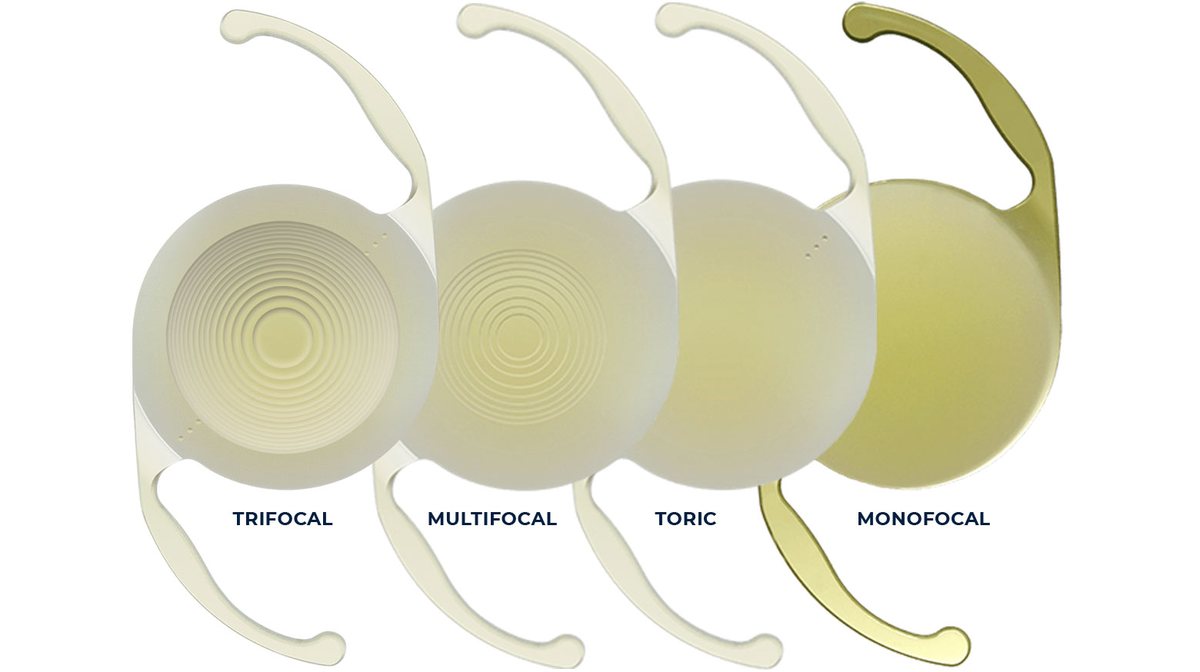
The image below shows the actual appearance of the main lens types; the diagrams beneath show how each type focuses light.

Intraocular lens types: the actual appearance of trifocal, multifocal, toric and monofocal lenses
Appearance of the main intraocular lens types, left to right: trifocal, multifocal, toric, monofocal. (The concentric ring pattern in the center shows the diffractive surface that splits light into multiple foci.)

Monofocal (single focus)

It has a single focal point, usually set for distance. Distant rays converge sharply on the retina; reading glasses may be needed for near. It offers the highest contrast and the best night-vision quality.

retina single focus
All rays converge at a single point; distance is sharp.

Advantage

Sharpest contrast and night vision; broadly suitable (can be preferred even in challenging eyes).

Limitation

Only one distance is sharp; glasses are needed for near (and often intermediate).

Enhanced monofocal (monofocal-plus)

Optically it is still single-focus, but a slight power increase in the center extends the focus somewhat, adding a little for intermediate distance (computer, car dashboard). The night-vision profile stays similar to a monofocal.

extended focus
The focus spreads over a short range, a small contribution to intermediate distance.

Advantage

Monofocal-grade night vision plus slightly better intermediate distance.

Limitation

Glasses are still needed for near reading.

Toric (astigmatism-correcting)

An astigmatic cornea is shaped like a rugby ball: steeper in one axis and flatter in the other, so it cannot bring light to a single point. A toric lens balances this with different power in the two axes. Axis alignment is critical: the lens must sit at the correct angle.

Astigmatic (two foci) With toric (single focus)
A toric lens brings the two foci of astigmatism to a single focus on the retina; axis alignment matters.

Advantage

Sharpens distance vision by reducing astigmatism; every lens class can have a toric version.

Limitation

Must sit on the correct axis; rarely a small rotational adjustment may be needed.

Multifocal / Trifocal

The concentric rings on its surface (diffractive steps) split incoming light into several foci at once: distance, intermediate and near. The brain selects the image that is in focus. Because the light is split, halos/glare around lights at night and a slight loss of contrast can occur.

retina near intermediate distance
Concentric rings split light into three foci: near, intermediate and distance.

Advantage

The highest spectacle independence at every distance; strong near vision.

Limitation

Possible halos/glare at night and slight contrast loss; the brain's adaptation (neuroadaptation) can take weeks to months.

Extended depth of focus (EDOF)

Instead of separate foci, it stretches a single focus over a continuous range. It gives good distance and intermediate vision and partial near vision; night-vision effects are usually fewer/softer than with a trifocal.

continuous focus range
The focus spreads over a continuous range rather than a single point: distance + intermediate + partial near.

Advantage

Continuity in the distance-to-intermediate transition; fewer halos than a trifocal. Often preferred by night drivers.

Limitation

Glasses may occasionally be needed for very small near print.

The core trade-off: spectacle independence ↔ night-vision quality

General rule: as spectacle independence increases, night-vision effects (halos/glare) tend to increase too. The ideal choice is made along this balance according to your priority.

Spectacle independence → ← Night-vision quality Monofocal Enhancedmonofocal EDOF Trifocal Toric versions can be added to any class when astigmatism is present.
Left to right, spectacle independence increases; right to left, night-vision quality/contrast increases.

Surgical steps (phacoemulsification)

The steps below schematically show the typical flow of cataract / premium lens surgery. Use the forward/back arrows to move through them.

1. Drop anesthesia and a small incision Schematic illustration; the actual surgery is individual to the surgeon.
1 / 6
In femtosecond laser-assisted surgery (FLACS), the incision, capsule opening and softening of the lens can be done with a laser; the subsequent steps proceed similarly.

Recovery and the "secondary cataract" (PCO)

Vision usually clears gradually over a few days to weeks; the prescribed drops are used regularly, and rubbing the eye and heavy straining are avoided for a while. With multifocal/EDOF lenses, the brain's adaptation to the new image (neuroadaptation) can take weeks to months.

Months to years later, the membrane behind the lens (the posterior capsule) can become cloudy; this is called posterior capsule opacification (PCO) and is not the cataract "coming back." It is resolved with a short, painless YAG laser procedure.

Estimated "ideal lens type" quiz

Important: This quiz is for information only; it is not a diagnosis, medical advice or a prescription. The lens that suits you can be determined only by your doctor after a detailed examination and biometry. The result is just a starting point for a conversation with your doctor.

1. Your age range?

2. What is your vision priority?

3. How often do you drive at night?

4. How much near work do you do (reading, phone, handcraft)?

5. Have you been told you have astigmatism?

6. How important is full independence from glasses to you?

7. Your tolerance for effects like halos/glare around lights at night?

8. Do you have any known eye condition?

ESTIMATED SUGGESTION, NOT A DIAGNOSIS

Remember: This is only a starting point. The real choice is made together with your doctor after your eye's measurements and examination.

Frequently asked questions & myths

Does a cataract come back after surgery?

The lens that is removed does not come back. Later cloudiness is usually posterior capsule opacification (PCO) and is treated with a YAG laser.

Is a premium lens "the best" for everyone?

No. In conditions such as macular disease, advanced glaucoma, severe dry eye or an irregular cornea, a monofocal lens is often more suitable for the sharpest and safest vision.

Does everyone who gets a multifocal lens become glasses-free?

In most people the need for glasses drops markedly, but it is not guaranteed; night halos/glare can occur and it is not suitable for every eye. Clarifying expectations beforehand is important.

Do you need to wait for a cataract to "ripen"?

Usually no. Modern surgery is often easier and safer with softer cataracts; the timing is set according to your visual needs.

Is laser (FLACS) cataract surgery always better?

FLACS adds precision at certain steps; however, in routine cases a clear superiority in the final visual outcome has not been proven. The method is assessed individually.

Want to find out which lens suits you?

The final decision is made after biometry and a detailed examination. Contact me for an appointment.

Book via WhatsApp