Laser refractive surgery aims to reduce the refractive errors that create a need for glasses or contact lenses by reshaping the cornea. On this page you will find the LASIK, PRK/transPRK and SMILE methods, who may be suitable, and the steps involved.
How is the cornea reshaped?
The cornea is the clear front layer of the eye and does most of the focusing. By precisely changing the cornea's curvature, the laser brings light to a focus on the retina: in myopia the center is flattened, in hyperopia tissue is removed from the periphery so the center is steepened, and in astigmatism the irregularity is corrected.
Solid line: corneal curvature before the procedure. Dashed line: the new curvature targeted by the laser.
Methods
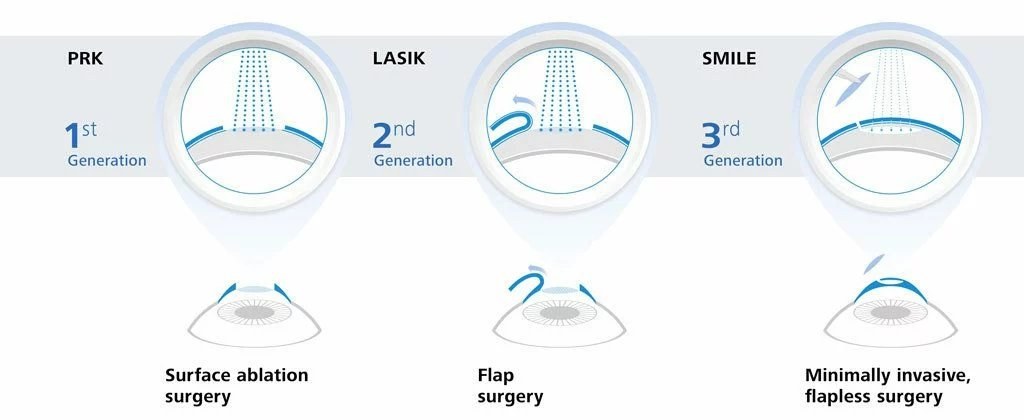
The three main methods reach the cornea differently. Select from the tabs to compare.
The three main methods, PRK: surface ablation · LASIK: with a flap · SMILE: flapless, small-incision. (Labels in the image are in English.)
A thin, hinged flap is created with a femtosecond laser (or microkeratome); the tissue beneath the lifted flap is reshaped with the excimer laser, and the flap is replaced and adheres without sutures. Vision usually recovers quickly.
Drop anesthesia and an eyelid speculum.
Creating a hinged flap with a femtosecond laser/microkeratome.
Lifting the flap.
Reshaping the cornea with the excimer laser.
Repositioning and smoothing the flap (no sutures needed).
Advantage
Fast visual recovery, little discomfort.
Caution
Flap-related (rare) risks; temporary dry eye; may not be suitable for a very thin cornea.
No flap is created. The surface epithelium is removed (mechanically, with alcohol or with the laser) and the corneal surface is reshaped with the excimer laser; a protective contact lens is worn until it heals. In transPRK the laser treats both the epithelium and the tissue in one step, "no-touch." Recovery is slower than LASIK, but there is no flap-related risk and it is biomechanically robust.
Drop anesthesia.
Removing the epithelium (in transPRK the laser does this in the same step).
Surface reshaping with the excimer laser.
Protective contact lens.
The epithelium regrows over a few days.
Advantage
Flapless; advantageous for thin corneas and contact-sport athletes; durable.
Caution
More discomfort in the first few days; vision clears more slowly.
A single femtosecond laser creates a lens-shaped lenticule inside the cornea, leaving the surface largely intact; the surgeon removes it through a small incision. No flap and no excimer are used. Because the upper corneal layers are largely preserved, the corneal nerves are affected less and the rate of dry eye is lower; it is also biomechanically advantageous. It is used mainly for myopia and myopic astigmatism (limited for large astigmatism and hyperopia).
Drop anesthesia and eye fixation (suction).
Creating a lenticule plus a small incision inside the cornea with the femtosecond laser.
Separating the layers of the lenticule.
Removing the lenticule through the small incision.
The cornea seals on its own (no flap).
Advantage
Flapless and excimer-free; less dry eye; biomechanical durability; suitable for contact sports.
Caution
Mainly myopia/astigmatism; limited for hyperopia and high/irregular astigmatism; early recovery slightly slower than LASIK.
Which method for whom?
The choice is made according to corneal thickness and shape, the type and amount of refractive error, dry eye, lifestyle and occupation:
Thin cornea: Surface ablation (PRK/transPRK) or SMILE may be preferred over LASIK.
Tendency to dry eye: SMILE and PRK are advantageous because they affect the corneal nerves less.
Contact sports / occupation (boxing, martial arts, etc.): Flapless SMILE and PRK eliminate the risk of flap displacement.
Priority on fast recovery: LASIK usually offers the fastest visual recovery.
High/irregular astigmatism or hyperopia: Excimer-based LASIK/PRK provides more comprehensive correction.
In suitable candidates, all three methods offer similar final visual acuity and safety. The answer to "which is better" depends on the person, the cornea and the lifestyle.
Candidacy, contraindications and preoperative tests
General candidacy: over 18, a prescription that has been stable for about a year, sufficient corneal thickness, a regular corneal topography and a healthy ocular surface.
Situations where it may not be suitable
Keratoconus or suspected keratoconus (important; operating on hidden keratoconus can lead to ectasia)
Insufficient corneal thickness
Pregnancy / breastfeeding period
Uncontrolled autoimmune disease
Marked dry eye, a very large night pupil, unstable prescription
Preoperative evaluation
It includes corneal topography and tomography (front/back surface and thickness maps), pachymetry (thickness), tear assessment, pupil measurement, refraction and a detailed eye examination. Tomography is the gold standard for screening the risk of ectasia (thinning).
If the cornea isn't suitable: ICL (intraocular lens)
With a high prescription, a thin/borderline cornea or a suspicious topography, a laser that thins the cornea may not be suitable. In that case an ICL (phakic intraocular lens) is an option: without touching the natural lens, an additional lens is placed in front of it; it is an approach that removes no tissue (and can be removed if needed).
An ICL is an additional lens placed in front of the natural lens; the cornea is not thinned.
Recovery, risks and realistic expectations
Recovery varies by method: with LASIK most people return to daily life in 1-2 days; in PRK the protective lens stays for a few days and vision clears over weeks; in SMILE mild early blurring improves with time.
Possible side effects include temporary dry eye, halos/glare around lights at night (more likely with a large pupil), under/over-correction or regression, and the rare ectasia (thinning). Results vary from person to person; no procedure guarantees a particular outcome.
Laser pre-suitability test
Important: This test is for information only; it is not a diagnosis, medical advice or a suitability decision. Whether laser suits you can be determined only with corneal topography, thickness (pachymetry) measurement and a detailed examination. This test is only a starting point.
1. Your age?
2. How has your glasses/contact prescription been over the past year?
3. Have you been told any of the following about your cornea?
4. Do you have serious or persistent dry-eye complaints?
5. Do you have any known active eye disease?
6. Have you had previous eye or corneal surgery (including prior laser)?
7. Are you currently pregnant or breastfeeding?
8. Do you have an uncontrolled systemic disease (autoimmune: rheumatoid arthritis, Sjögren; or uncontrolled diabetes)?
PRELIMINARY ASSESSMENT, NOT A DIAGNOSIS
Remember: Definitive suitability is determined only with corneal topography, pachymetry and an examination. Whatever the result, the decision is made together with your doctor.
Sık sorulan sorular & yanlış bilinenler
Is the claim that "eye doctors don't get laser themselves and wear glasses" true?
On the contrary. In a study of surgeons who perform laser vision surgery (Kezirian et al., J Cataract Refract Surg, 2015), about 62% of refractive surgeons with a treatable refractive error had laser vision correction (LVC) themselves; that rate is roughly 5 times the frequency of refractive surgery in the general population and is higher than almost every profession outside the military. Moreover, more than 90% of the surgeons also recommended or performed the procedure on close relatives such as a parent, spouse or child. In short, those who best know its risks and benefits also choose the treatment for themselves in suitable candidates.
Can laser correct any prescription?
No. With a thin cornea, a very high prescription or keratoconus, laser may not be suitable; other options such as ICL are considered.
Will I never wear glasses again?
In most people the need for glasses drops markedly, but age-related near-vision difficulty (presbyopia) can still appear over time; a small regression is also possible.
Can laser surgery cause blindness?
Serious vision loss is extremely rare; most side effects are mild and temporary. Still, every surgical procedure carries risk; that is why the pre-assessment matters.
Is SMILE always better (or worse) than LASIK?
No. Each is preferred for certain profiles: dry eye/biomechanics/contact sports favor SMILE or PRK; high/irregular astigmatism and hyperopia may favor excimer-based LASIK/PRK.
Does laser also end the need for reading glasses?
Standard distance correction does not stop age-related near-vision loss. If desired, strategies such as "monovision" are assessed individually.
Wondering whether you're suitable for laser?
Suitability is determined only by corneal topography and a detailed examination. Contact me for an appointment.